
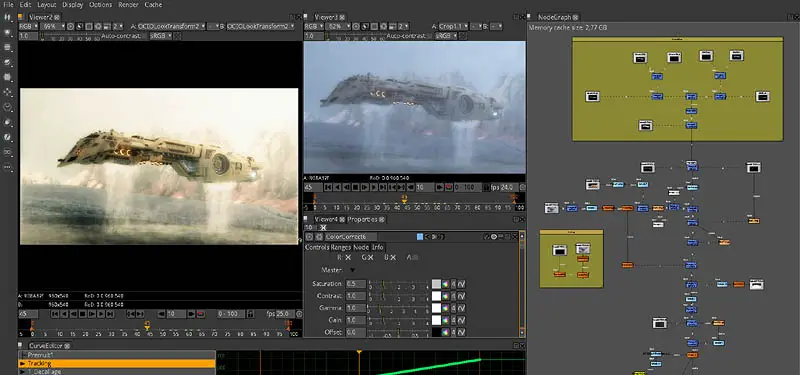
After several months of testing and debugging, the developers of Natron have released the final, stable version of the cross-platform open source compositing software. New features include:
- Transform effects (such as Transform, CornerPin, Dot,
Switch) now concatenate: the filtering is now only applied by the
“bottom” node of the transform chain - The font of the application and its size are now
customizable in the preferences - Caching behavior has been modified, making the software
much faster - New HSVTool node to adjust hue, saturation and brightness,
or perform color replacement. - New HSVToRGB & RGBToHSV nodes to convert between
these 2 color-spaces - New Saturation node to modify the color saturation of an
image - New DiskCache node – allows to cache a branch of the
compositing tree to re-use it later on without re-computing the images - When zooming out of the node-graph, all texts on nodes /
arrows will be hidden to increase performances when handling huge
compositions - Tracker: all tracks are now multi-threaded for better
performance - Roto: Selected points can now be dragged from everywhere
within the bounding box instead of only the cross-hair - Roto: It is now possible to move a bezier just by dragging
a part of the curve where there is no control point - Roto: Holding shift while dragging a scale handle of the
bounding box will now scale only the half of the shape on the side of
the handle - Improved parameters alignment and spacing in the settings
panel - A new tab in the preferences is now dedicated to plugins’
management – you can now choose to enable/disable plugins - A new Auto-turbo setting has been added: when enabled, the
Turbo-mode (originally toggleable with the button on the right of the
media player) will be enabled/disabled automatically when playback is
started/finished.
Plus other enhancements and bug fixes. You can download Natron and find
out more information on the official
website.
Also of note, the developers have disclosed the features they’ll be
working on for v1.1 and future versions of the
software: Python 3 scripting integration, Optical
Flow nodes (VectorGenerator, Motion Blur, Retimer, RollingShutter),
natural matting (extract a foreground of an image without necessarily having a
green/blue-screen background), roto-painting, dope sheet, deep data
support.
More on Natron’s roadmap.





That’s awesome, but I can’t help but wonder how is it even legal to make it look and work just like Nuke. Anyone?
I’d expect ‘Cease and Desist’ or ‘Takedown’ legal notices in Natron’s near future…
They are changing the interface more, but keeping the workflow. So, it might be good enough.