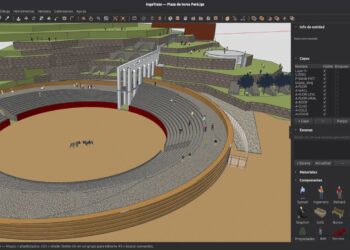
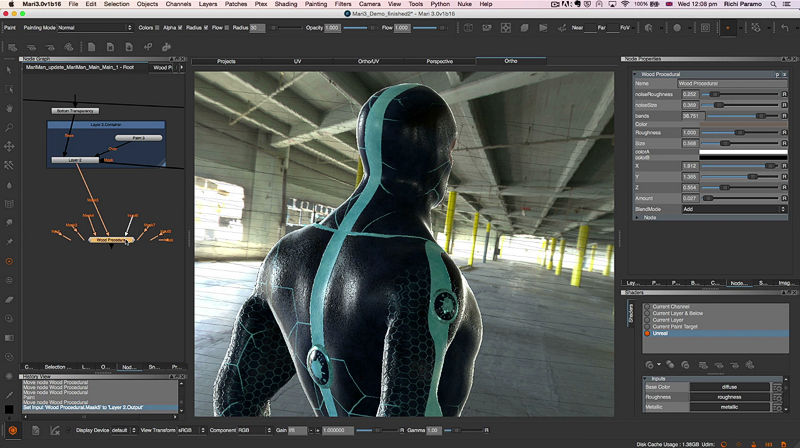
New features in The Foundry’s 3D painting software include:
- OpenSubdiv support – lets you work with subdivision surface meshes without the need to translate or pre-subdivide them
- Color space management
- Exposed node graph – create and edit channels and layers in
a more efficient and visual manner - Custom group nodes
- Arnold, V-Ray, Unreal and Redshift shaders
- FBX geometry support
- Session scripts – let you create a lightweight archive of a
project that can be combined with other archives, keeping all data
intact. The ability to merge projects lets you see assets in context
with other assets, share useful data for reuse, or set up project
templates. - Modo rendering and baking
- Rendering integration APIs – four new APIs that help
studios integrate Mari with their rendering pipeline, reducing the need
to transfer files between applications and resulting in faster
iterations and a more accurate understanding of the final context - Enhanced texture transfer – Mari’s Texture Transfer system
uses generated point cloud data to transfer textures between two
different models, without the need for matching topology or UVs. In
Mari 3, you can use this data to generate height and normal maps
between high and low polygon models, seamlessly blur across patch
boundaries, and correctly transfer overlapping UVs. - Entity locators
- Safe mode
- Extended access to selection groups
Mari 3 is available for Windows, Linux and Mac OS X through permanent (starting at $2013) and rental licensing (starting at $585) options. Watch a new features video and find out more on The Foundry’s website.